
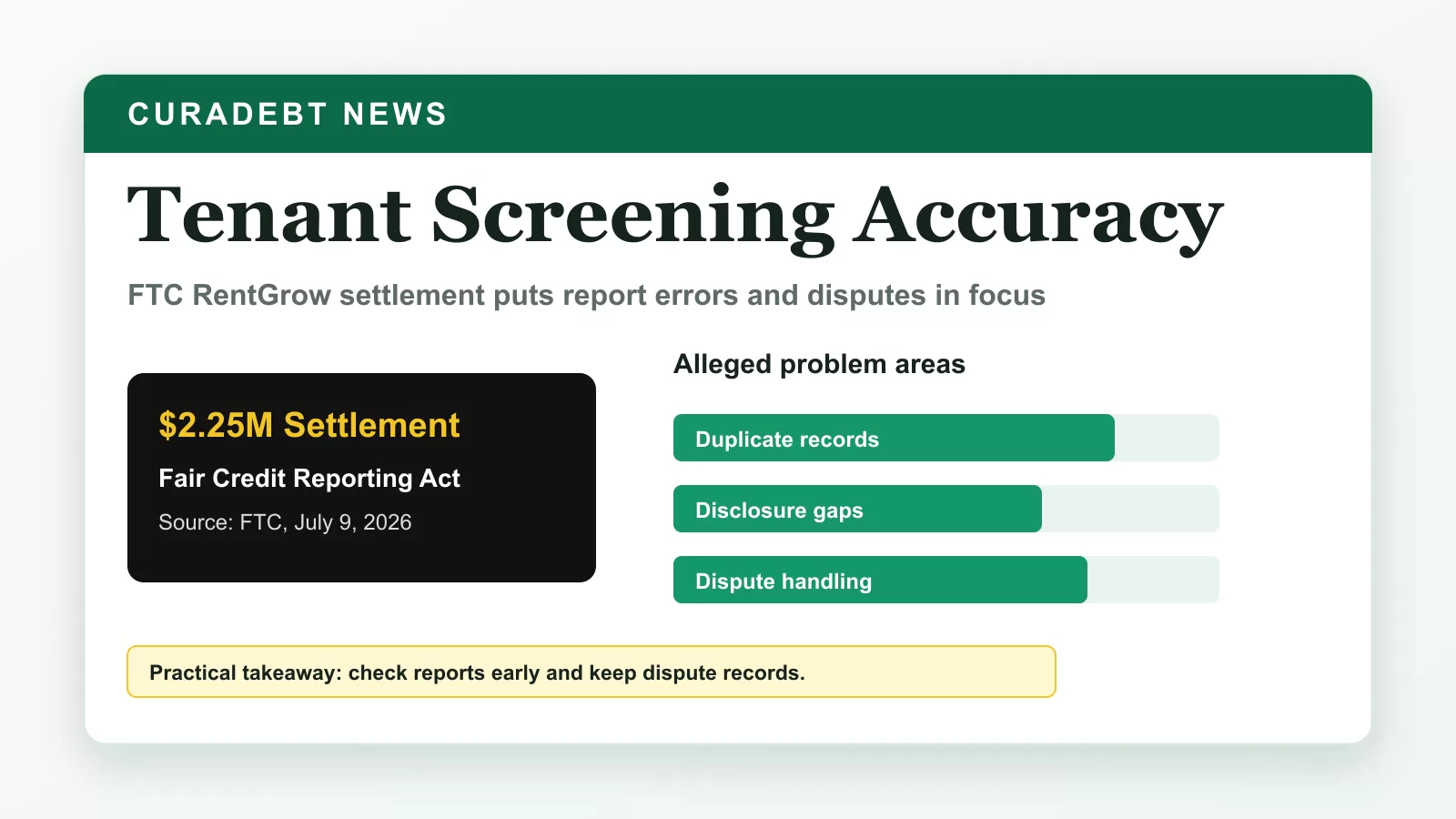
The FTC says RentGrow will pay $2.25 million to settle allegations involving tenant screening report accuracy, duplicate records, consumer disclosures, and dispute handling. For renters, the case is a reminder that background-report errors can become real housing and money problems.
Key Takeaways
- The FTC announced on July 9, 2026 that RentGrow will pay $2.25 million to settle allegations tied to the Fair Credit Reporting Act and the FTC Act.
- The agency alleged RentGrow failed to use reasonable procedures to ensure maximum possible accuracy in tenant screening reports.
- The complaint focused partly on duplicate case records and multiple entries for the same criminal or eviction action.
- The FTC also alleged disclosure and dispute-handling failures, including misleading some consumers about dispute outcomes.
- Renters who are applying for housing may want to check screening reports early, keep records, and act quickly if a report appears wrong.
What The FTC Alleged
The Federal Trade Commission said RentGrow, a tenant screening consumer reporting company, will be required to pay a $2.25 million monetary penalty under a proposed order filed by the Department of Justice on the FTC's behalf. The FTC said RentGrow provides consumer reports to landlords and property managers for rental decisions.
According to the FTC, the complaint alleged that RentGrow violated the Fair Credit Reporting Act by failing to maintain reasonable procedures to ensure the maximum possible accuracy of its reports. The FTC said some reports included duplicate case records or multiple entries for the same criminal or eviction action, which could make an applicant look like they had more convictions or eviction suits than they actually had.
The agency also said RentGrow allegedly failed to disclose all information and data sources when consumers asked for their reports, failed to follow certain dispute-handling requirements, and misled some consumers about what happened after a successful dispute.
Why Tenant Screening Reports Can Become A Money Issue
Tenant screening reports can affect more than whether someone gets an apartment. The FTC's consumer guidance says a negative decision can include being denied, charged more rent, asked for a larger security deposit, or required to use a cosigner.
That matters for households already trying to manage credit cards, loans, rent, and cash flow. A larger deposit or a delayed move can force someone to lean harder on credit, while a housing denial can create extra application fees and urgency. If someone is already weighing debt consolidation options, rental-screening pressure is another reason to compare total monthly obligations carefully instead of reacting to one bill at a time.
What Renters Can Check Before Applying
The FTC's tenant background check guidance says renters can ask what information a landlord uses before paying an application or screening fee. It also notes that tenant screening companies may review items such as credit card account status, payment history, missed rent, housing court records, bankruptcy, lawsuits, and criminal records.
The CFPB's RentGrow company listing says consumers can request a free screening report from RentGrow if the company has a file on them, and that asking for your own consumer reports does not hurt your credit scores. The CFPB also says consumers have the legal right to dispute inaccurate or incomplete information in a consumer report.
For people carrying balances while trying to qualify for housing, the credit side still deserves attention. A plan for credit card debt relief should be based on the full picture: what is accurate on the report, what can be disputed, what payments are due soon, and what housing decision is coming next.
My Take
This settlement is not just about one company's process. It highlights a broader problem: consumers often discover report errors only after a high-stakes decision has already been made. By then, the practical damage may be a denied application, a bigger upfront deposit, or a scramble to prove that a record is wrong or duplicated.
The best practical response is boring but powerful: get the report when you can, read it line by line, and keep proof. If the report mixes up people, repeats the same case, omits an outcome, or includes outdated information, the dispute needs to be clear and documented. And if debt stress is making every application feel tighter, comparing debt relief services can help clarify which options fit the timing, risks, and budget.
What You Could Do Now
- Ask a landlord or property manager which tenant screening company will be used before you pay a screening fee.
- Request your tenant screening report when available, especially if a rental decision may depend on it.
- Compare names, addresses, court records, eviction items, criminal-record entries, and account information against your own documents.
- If you find an error, dispute it in writing and include copies of supporting records instead of originals.
- Keep copies of the dispute, delivery confirmation, landlord notices, report pages, and any updated results.
- If debt or credit pressure is affecting housing plans, compare realistic next steps before taking on more expensive short-term credit.
Primary Sources
- Federal Trade Commission: RentGrow to Pay $2.25 Million to Settle FTC Allegations the Company Violated the Fair Credit Reporting Act and FTC Act
- Federal Trade Commission case page: RentGrow, Inc., U.S. v.
- FTC Consumer Advice: Tenant Background Checks and Your Rights
- CFPB consumer reporting company listing: RentGrow, Inc.
This article is for educational purposes only and is not legal, tax, credit repair, or financial advice. CuraDebt is a private company and is not affiliated with, endorsed by, or acting on behalf of the Federal Trade Commission, the Department of Justice, the Consumer Financial Protection Bureau, RentGrow, Yardi Systems, or any government agency.
