

Comenity Capital Bank Debt Settlement Letter: 55% Saved On A $2,025.86 Balance
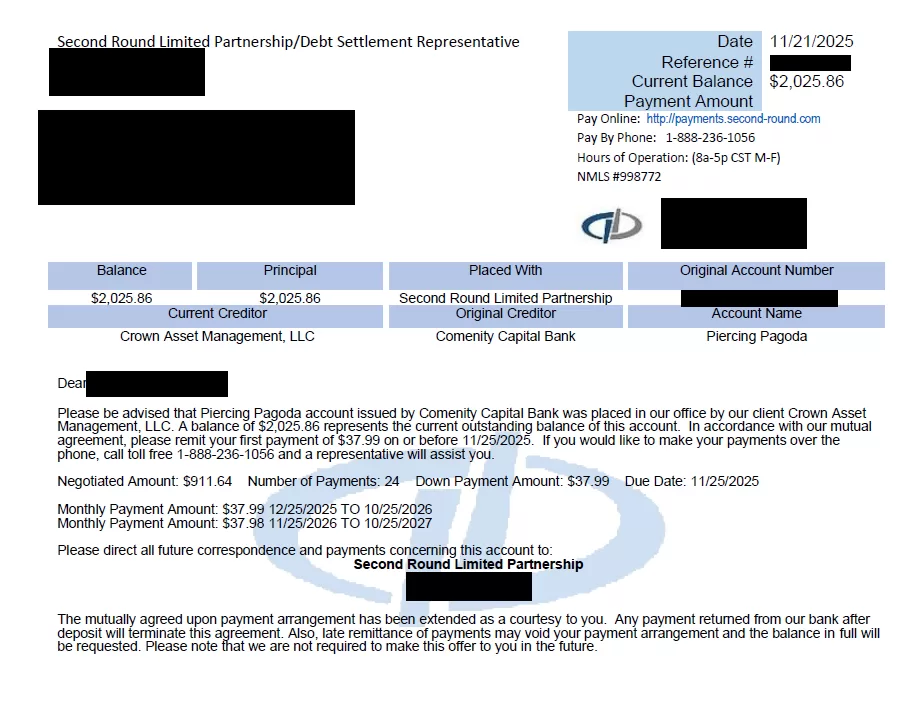
In this November 21, 2025 letter, a Piercing Pagoda account first issued by Comenity Capital Bank, now owned by Crown Asset Management, was settled for $911.64 on a $2,025.86 balance, in 24 monthly payments of about $38. That is about 55% less than the balance owed.
What Does This Settlement Letter Show?
This letter shows a debt buyer accepting $911.64 on a $2,025.86 store card balance, spread over 24 payments. Store credit cards, like the Piercing Pagoda card issued by Comenity Capital Bank, are often sold to debt buyers after they go unpaid. Here the account was bought by Crown Asset Management and placed with Second Round, a collection agency, which confirmed the settlement terms in writing.
| Detail | From the letter |
|---|---|
| Original creditor | Comenity Capital Bank (Piercing Pagoda account) |
| Current creditor | Crown Asset Management, LLC |
| Collection agency | Second Round Limited Partnership |
| Letter date | November 21, 2025 |
| Balance owed | $2,025.86 |
| Settlement amount | $911.64 |
| Savings | $1,114.22 (about 55%) |
| Payment plan | 24 payments: $37.99 down by November 25, 2025, then monthly payments of $37.99 and $37.98 through October 2027 |
The Settlement Letter
Personal details are blacked out to protect the client's privacy.
How Does A Debt Settlement Like This Work?
Debt settlement is an agreement in which a creditor or debt buyer accepts less than the full balance as payment in full. It is usually considered after someone has fallen behind and cannot realistically repay the whole amount. The general steps look like this:
- Funds are set aside. Money builds up in an account the client controls while accounts are negotiated one at a time.
- An offer is negotiated. The creditor or collector agrees to a reduced amount, paid in one sum or in installments.
- The terms are put in writing. A letter like this one confirms the amount, the payment dates and what happens if a payment is missed.
- Payments are made as agreed. Once the last payment clears, the account is treated as settled.
- Sold accounts can still be settled. When a debt buyer owns the account, the settlement is made with the buyer or its collector, not the original bank.
What Should A Settlement Letter Include?
A good settlement letter states the creditor, the account, the balance, the agreed amount, the payment dates, and that the account will be considered settled once the payments are made. Before paying, check that it shows:
- The original creditor and the current owner or collector of the account
- The balance owed and the settlement amount
- Each payment amount and due date, if paid in installments
- A statement that the debt is resolved or settled in full after the final payment
- What happens if a payment is late or returned
Many people ask whether to pay on a phone promise. It is safer to get the offer in writing first, keep a copy, and pay only the amount and dates the letter lists.
What Should You Know Before Settling A Debt?
Settlement can save money, but it affects your credit, may have tax consequences, and results vary by creditor. The amount a creditor accepts depends on the creditor, the age of the account, the balance and the person's finances, so no specific percentage can be promised.
- Credit impact. Settling for less than the full balance, and the missed payments that usually come before it, can lower credit scores. Late payments can stay on credit reports for up to seven years.
- Fees. Debt settlement companies charge fees. Under the FTC's Telemarketing Sales Rule, companies that sell by phone cannot collect fees on a debt until it has been settled and at least one payment has been made under the agreement. See the FTC's guide to getting out of debt.
- Taxes. Creditors generally must file Form 1099-C when $600 or more of debt is canceled, and canceled debt may count as taxable income unless an exclusion, such as insolvency, applies. See IRS Topic 431.
- Missed payments can undo the deal. Most settlement letters say the agreement can be voided if a payment is late or returned.
See more real examples in our client settlement letters, or compare debt relief options.