

Chase Bank Debt Settlement Letter From July 2004
This page preserves a dated Chase settlement letter so the written terms can be examined instead of guessed at. The image and figures below preserve the account-specific evidence while the surrounding guidance explains how to read it.
Check Your Debt Relief Options
No cost to check options. No obligation.
Prefer to talk now? Call 1-877-850-3328What This Chase Settlement Letter Documents
This archived record is dated July 2004. It identifies a balance of $13,203.16 and a settlement amount of $3,300.00. The difference between those two stated amounts is displayed as a 75% documented balance reduction.
| Item | What This Letter Shows |
|---|---|
| Creditor Or Account Name | Chase |
| Document Date | July 2004 |
| Balance Stated In Letter | $13,203.16 |
| Settlement Amount In Letter | $3,300.00 |
| Documented Balance Reduction | 75% |
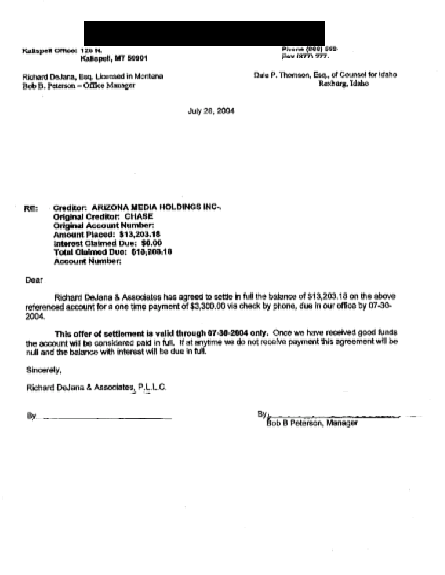
Historical settlement letter kept in the CuraDebt archive. Personal identifying details are redacted for privacy. See more settlement letters.
Calculated only from the balance and settlement amount shown in this letter. This is not net savings and does not include program fees or possible tax consequences.
How To Read This July 2004 Agreement
Check whether the document uses one payment or several, and whether missing a due date changes the arrangement. The historical figures shown here are $13,203.16 and $3,300.00; the letter image remains the controlling source for the exact wording of this example.
The safest use of a historical example is to learn what should be documented. It should not be used to infer that the same creditor, a collector, or an independent provider will produce the same terms on another account.
A Verification Checklist For This Letter Type
Use the scanned document and the summary together. Before acting on a different agreement, verify each of the following in that agreement's own wording:
- The sender is authorized to discuss the account
- The original creditor and current owner are distinguished
- Any condition attached to the offer is understandable
- The final-payment consequence is written down
- No important term depends only on a phone call
When an account has changed hands, confirm whether the sender is the original creditor, a servicer, a collection agency, or the current owner. That distinction can affect which records should be matched before payment.
What To Keep After The Final Payment
Retain the complete agreement, payment confirmations, bank records, and any final account correspondence. If the account status or balance is later inconsistent with the written terms, those records provide the clearest starting point for a correction request.
For a current account, compare the full written terms with other available paths rather than choosing from a historical percentage alone. Compare debt relief options or review how a debt settlement program is structured.
Document Review Notes For This Specific Example
Reading The July 2004 Figures Together
For the document shown here Chase places the recorded amounts in July 2004. The letter identifies a balance of $13,203.16, with written terms totaling $3,300.00. Subtracting those figures produces $9,903.16; the page expresses that difference as 75%.
What The $13,203.16 Balance Establishes
The number $13,203.16 is specific to the document on this page. The figure is not a qualification threshold or average. If a current account has other figures, verify the current record independently.
Why The $3,300.00 Amount Needs Written Context
The letter’s stated total of $3,300.00 matters only when read beside the rest of the agreement. A verbal quote does not establish accepted terms. With a present-day account, read the payment sequence together with the condition for completion.
How To Interpret The 75% Label
In the displayed example, 75% is a balance-to-settlement calculation. The percentage does not provide a promise about current settlement terms. A complete cost comparison keeps fees and potential tax treatment separate.
Using This Chase Record In A Broader Comparison
The page can document the figures used in this single example for Chase. That evidence does not choose the best current approach for another household. That comparison needs the person’s accounts, budget, credit goals, and available written terms.
A Paper Trail Built Around $13,203.16 And $3,300.00
The page highlights $13,203.16 beside $3,300.00 as a concise account summary. The scanned letter remains the source document. Let the recap guide the review without replacing the document.
Questions The July 2004 Letter Can And Cannot Resolve
The preserved letter records the named party, account amount, accepted total, and visible payment language. The record does not create present-day terms for a different consumer. Use current statements and written terms for everything the archive cannot answer.
Keeping The Chase Example Account-Specific
Each numeric reference on the page $13,203.16, $3,300.00, and 75% is tied to the document shown. Reading the figures as one set avoids turning history into a general promise. In any cross-page comparison, review the account type, written total, deadlines, and disposition wording.
A Step-By-Step Review Of This Archived Letter
1. Locate The Chase Account Reference
Open the review by confirming the institution name with the account details using records already in your possession. On the page shown here, the relevant creditor label is Chase and the document date is July 2004.
2. Reconcile $13,203.16 With $3,300.00
Trace the account amount to the agreed payment. The scanned letter identifies $13,203.16 and pairs it with $3,300.00. When a new agreement uses several payments, add them independently and confirm the sum matches the written total.
3. Find The Deadline Attached To The $3,300.00 Figure
The dollar figure needs a due date. Check the scanned agreement for when and how the stated amount must be received. Current timing must come from the current written offer.
4. Identify The Completion Language Behind 75%
A complete review finds what happens after every required payment clears. That wording is more important than the percentage alone. For the page summary, 75% describes only the mathematical difference between $13,203.16 and $3,300.00.
5. Preserve Evidence From The July 2004 Record
Store the letter with the account file with transaction records and follow-up correspondence. An isolated payment receipt does not show the agreement. The page keeps the account figures connected to their source.
6. Separate The Historical Result From A Current Decision
After the figures have been verified, look at today’s account-specific paths. The July 2004 example does not quote today’s account. Compare affordability, total cost, timing, account status, and credit priorities before choosing among repayment, consolidation, debt management, settlement, or another available route.
7. Use The Chase Letter As Evidence, Not A Promise
The document supports one limited conclusion: the scanned letter preserves one completed set of terms. It supplies no guarantee for a different balance. That distinction lets the page remain useful for research without presenting $13,203.16, $3,300.00, or 75% as a prediction.
Comparison Questions Raised By This Letter
Was The $3,300.00 Amount A Lump Sum Or Installments?
The figure needs to be read with its schedule. Read the payment paragraph in the July 2004 record rather than assuming a lump sum. For today’s account, compare the complete amount, the time allowed, and what occurs after a missed installment.
Did Chase Or Another Account Holder Issue The Letter?
The brand associated with a debt may differ from the current owner. Trace the party in the document through the available statements. Repeat that verification on a current account.
Does The 75% Figure Predict Credit Impact?
The document’s arithmetic cannot predict reporting impact. Reporting and score effects vary with the full credit profile and account timeline. The 75% label on this page remains limited to the difference between $13,203.16 and $3,300.00.
Could The $13,203.16 Account Create A Tax Question?
Canceled debt can have tax consequences in some circumstances. The settlement document is not a substitute for tax guidance. Save tax correspondence and ask a qualified tax professional about the specific facts.
How Should This July 2004 Example Be Used Today?
Use the archive to recognize important agreement fields, not as a price quote. Today’s choice requires current account information. The fact that the archived amount was $3,300.00 on a $13,203.16 balance does not set terms for another consumer.
What Makes This Chase Page More Than A Scanned Image?
The layout makes the creditor, date, amounts, and limitations independently scannable. It lets the image remain primary while making its key data easier to understand. The unique combination here is Chase, July 2004, $13,203.16, $3,300.00, and 75%.
Other Historical Chase Letter Examples
This archive contains more than one Chase document. The table is provided to compare dated records, not to calculate an average or predict a new result.
| Archived Example | Balance In Letter | Settlement Amount | Documented Reduction* |
|---|---|---|---|
| This Letter | $13,203.16 | $3,300.00 | 75% |
| March 2008 | $7,339.72 | $3,303.00 | 55% |
| 8/17/2011 | $17,419.71 | $1,741.97 | 90% |
| December 2007 | $5,234.00 | $2,427.00 | 53% |
*Each percentage compares only the balance and settlement amount shown in that letter. It is not net savings and does not include program fees or possible tax consequences.
Frequently Asked Questions
What does this Chase settlement letter document?
It records one historical account with a stated balance of $13,203.16 and a settlement amount of $3,300.00. The displayed 75% reduction is calculated from those two figures only.
Is this Chase letter a current offer?
No. The document is dated July 2004 and belongs to one archived account. It does not state what Chase or another account owner will offer today.
Is the 75% reduction net savings?
No. It compares the balance and settlement amount in this letter. It does not subtract program fees or account for possible tax consequences, so it should not be described as net savings.
How can I compare this Chase example with my account?
Use the document to identify terms that should be clear in writing, such as the account, total amount, due dates, and treatment of the remaining balance. Do not use its percentage as an estimate for a different account.
Is a payoff statement the same as a settlement letter?
Usually not. A payoff statement generally shows the amount needed to pay an account in full. A settlement letter may document acceptance of less than the stated balance under specific conditions.
Is a settlement request letter the same as a settlement offer?
No. A request asks a creditor or collector to consider terms. An offer or agreement records terms the recipient is prepared to accept. Do not assume a request was accepted without written confirmation.
What should a debt settlement offer letter include?
It should identify the account, state the total amount required, list payment dates or a deadline, and explain how the remaining balance will be treated after the required payment is received.
Why are personal details removed from the displayed letter?
Names, addresses, and account details are redacted to protect privacy. The creditor name and financial terms needed to understand the historical example remain visible.