
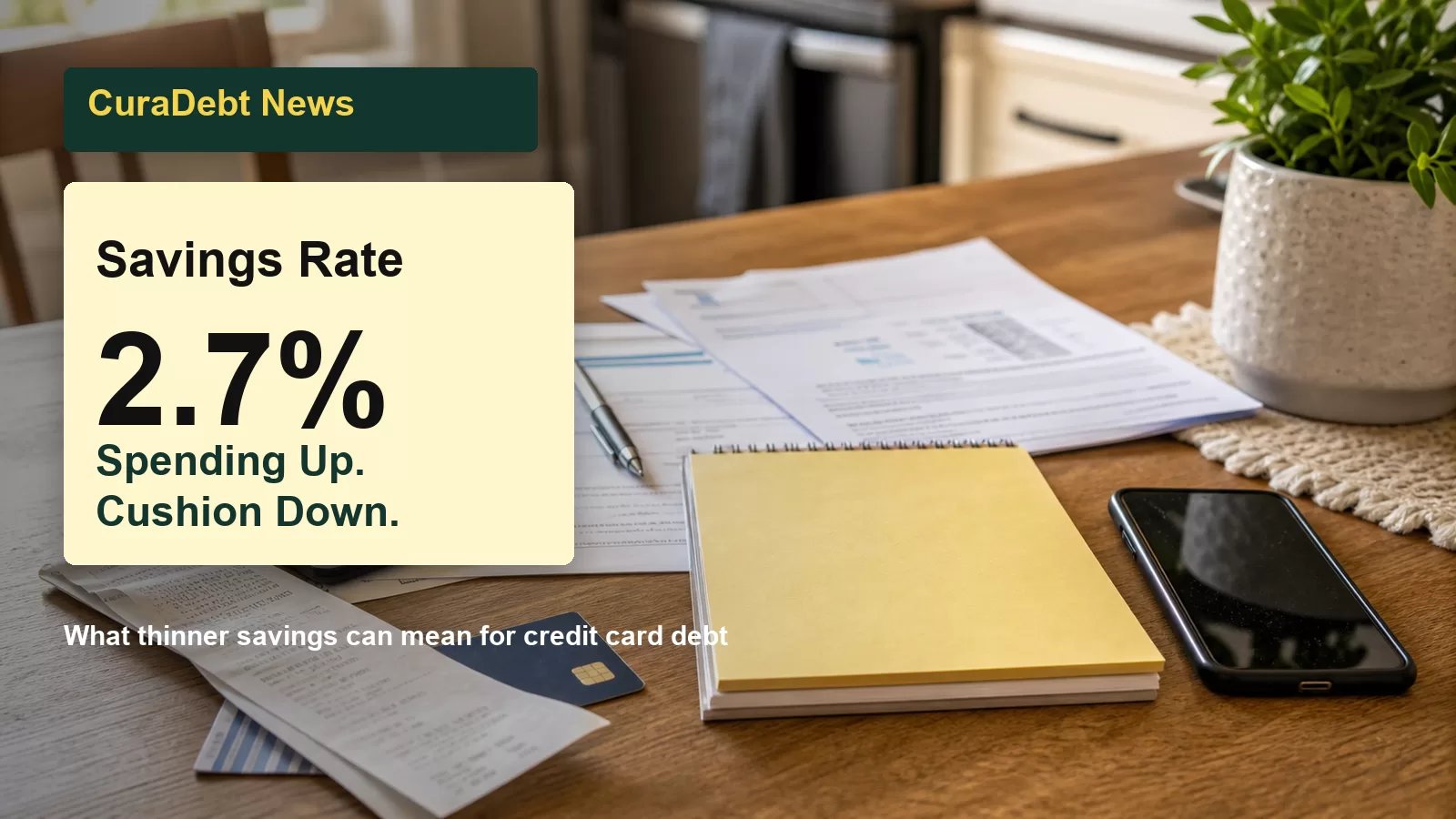
BEA's July 30 report shows June household spending rose while the personal saving rate was only 2.7%. For people already carrying credit card balances, personal loans, or other monthly debt, that smaller cushion can make one surprise bill harder to absorb.
Key Takeaways
- BEA said personal income increased 0.2% in June while consumer spending increased 0.3%.
- The personal saving rate was 2.7% in June, with personal saving estimated at $646.1 billion.
- BEA also reported that the PCE price index was up 3.7% from a year earlier, while core PCE was up 3.3%.
- A thin savings cushion can make it harder for households with credit cards or personal loans to handle surprise expenses without adding debt.
- The practical takeaway is to check cash flow before missed payments, new borrowing, or consolidation decisions reduce flexibility.
What The BEA Report Shows
The Bureau of Economic Analysis released its June 2026 Personal Income and Outlays report on July 30. The report said personal income increased 0.2% in June, disposable personal income also increased 0.2%, and personal consumption expenditures increased 0.3%.
That gap is small, but it is the part of the report that matters most for household budgets. Spending grew a little faster than income in June, while personal saving was $646.1 billion and the personal saving rate was 2.7%.
BEA also said the PCE price index was 3.7% higher than a year earlier. Excluding food and energy, the PCE price index was up 3.3% from June 2025. In plain English, many households are still spending into an environment where prices are meaningfully higher than a year ago.
Why A Thin Savings Cushion Matters For Debt
A 2.7% saving rate does not mean every household is in trouble. Some people have emergency funds, stable income, or low monthly obligations. But for people already carrying credit card balances, personal loans, medical bills, or collection accounts, a thinner cushion changes the risk.
When there is not much money left after spending, one car repair, insurance bill, medical copay, rent increase, or income interruption can land on a credit card. If the card already has a balance, new charges may increase interest costs and make the payoff timeline longer.
That is why someone comparing credit card debt relief should look beyond the balance alone. The question is not only how much is owed. It is whether the current budget can keep up with minimum payments, necessities, and the next unexpected expense.
Where Spending Pressure Can Show Up First
Household stress often shows up gradually. A family may still be paying on time, but groceries, gas, utilities, insurance, or medical costs start moving onto cards. Minimum payments still clear, but the balances stop falling. Then a second account gets used for basics, and the budget becomes harder to read.
For some people, a debt consolidation option can simplify payments or lower interest costs. But consolidation can also fail if the monthly payment is set without accounting for the real pressure in the household budget. A thinner savings cushion makes that planning step more important, not less.
The same is true before taking on any new loan. If the budget already depends on credit cards for routine spending, adding another fixed payment can make the next hardship more expensive.
My Take
The most useful way to read this BEA report is not as a broad economic signal. It is a household-warning light. Spending is still rising, prices remain higher than a year ago, and the savings cushion is thin.
For someone with no debt, that may simply mean watching the budget more closely. For someone with credit cards, personal loans, or hardship-related balances, it is more serious. If the only way to absorb normal expenses is to keep using high-interest credit, the problem can compound quietly before a missed payment ever appears.
That is the moment to compare realistic next steps. Reviewing debt relief services, consolidation, hardship options, creditor communication, and budget changes before accounts fall behind can preserve more flexibility than waiting until the budget breaks.
What You Could Do Now
- Compare income and spending from the last 30 days using actual bank and card activity, not estimates.
- Separate routine expenses that are going onto credit cards from older card balances so you can see whether new debt is forming.
- Check whether minimum payments, rent or mortgage, utilities, insurance, tax payments, and personal loans still fit after food, gas, and medical costs.
- Build or protect even a small emergency buffer before taking on a new loan payment when possible.
- If balances are rising despite on-time payments, compare options before late fees, collection calls, or charge-offs narrow the choices.
For a related look at how lenders are handling consumer credit, the latest Federal Reserve credit-card lending survey found that banks tightened card standards in the second quarter.
Primary Sources
- U.S. Bureau of Economic Analysis: Personal Income and Outlays, June 2026
- U.S. Bureau of Economic Analysis: Personal Saving Rate
This article is for educational purposes only and is not legal, tax, credit repair, or financial advice. CuraDebt is a private company and is not affiliated with, endorsed by, or acting on behalf of the U.S. Bureau of Economic Analysis, the U.S. Department of Commerce, the Federal Reserve, or any government agency.
