
AAA's national average for regular gasoline was above $4 on July 30, while EIA's latest weekly data showed regular gasoline nearly a dollar higher than a year earlier. For households already juggling card balances, rent, groceries, and loan payments, fuel prices can quietly turn into a credit and cash-flow problem.
Key Takeaways
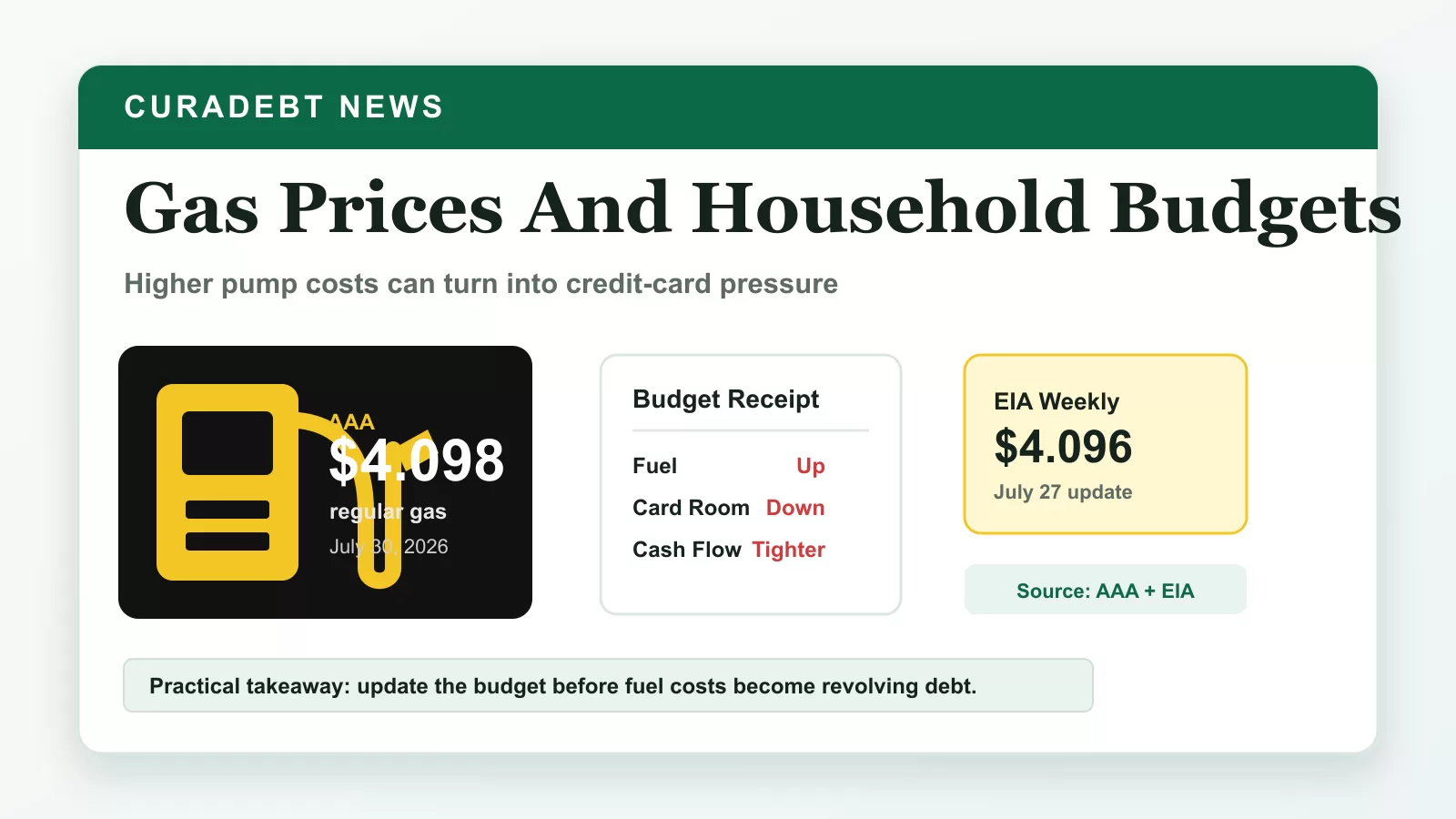
- AAA listed the national average for regular gasoline at $4.098 on July 30, 2026.
- EIA's July 27 weekly update showed regular gasoline at $4.096, up from $4.001 one week earlier and $3.140 a year earlier.
- AAA's July 23 report tied the latest pump-price spike to rising crude oil prices, volatility near the Strait of Hormuz, and broader regional instability.
- EIA's Short-Term Energy Outlook says retail gasoline prices can fall more slowly than crude oil prices when inventories are tight and the global petroleum risk environment remains elevated.
- For households with thin cash flow, higher fuel costs can increase credit-card reliance, make minimum payments harder to maintain, or force tradeoffs with other bills.
What The Latest Gas Price Data Shows
AAA's live fuel-price tracker showed the national average for regular gasoline at $4.098 on July 30, 2026. It also showed regular gasoline at $3.847 a month earlier and $3.140 a year earlier, making the current price a material change for drivers who budget around weekly fill-ups.
The U.S. Energy Information Administration's weekly Gasoline and Diesel Fuel Update told a similar story. For the week of July 27, EIA listed regular gasoline at $4.096 per gallon, compared with $4.001 the prior week and $3.140 a year earlier. EIA also listed on-highway diesel at $5.313 for July 27, up from $5.134 the prior week.
Those numbers matter because fuel is not a discretionary purchase for many households. If the commute, school pickup, medical visits, or a second job require driving, a higher pump price becomes a recurring budget line rather than a one-time surprise.
That same cash-flow issue showed up in BEA's latest household data, where the personal saving rate was 2.7% while spending kept rising, leaving less room for households already carrying card balances.
Where The Oil And Iran-Area Risk Fits
AAA's July 23 fuel report said the national average jumped 15 cents in a week to $4.09 and said rising crude oil prices were behind the spike at the pump. AAA also pointed to volatility along the Strait of Hormuz and instability in the region as factors pushing crude oil prices into the $90-per-barrel range.
That does not mean every gasoline move should be reduced to one geopolitical headline. EIA's Short-Term Energy Outlook gives a more practical consumer-budget frame: lower crude prices can help retail gasoline prices, but tight gasoline inventories, wholesale and retail margins, and uncertainty in the global petroleum market can keep retail prices from falling as quickly as crude.
In plain English: even if oil headlines calm down, drivers may not feel immediate relief at the pump. That lag is why a household budget can stay pressured after the breaking-news moment has passed.
Why Gas Prices Can Become A Credit Card Issue
For a household already carrying revolving balances, higher gasoline prices can create a chain reaction. A few extra dollars per fill-up may be manageable by itself, but repeated across multiple vehicles or long commutes, the added cost can push groceries, utilities, medical copays, or minimum payments onto a card.
That is where fuel inflation becomes a debt issue. If the card balance is already expensive, new gas-related charges can increase interest costs and make a payoff plan harder to sustain. A person comparing credit card debt relief should look at the full monthly cash-flow picture, including transportation costs that may not be easy to cut quickly.
The same logic applies to consolidation decisions. Higher gas costs do not automatically make a debt consolidation option better or worse, but they do change the monthly-payment math. A payment that looked affordable when gas was lower may feel tight if transportation costs rise and income does not.
My Take
The most useful way to read this story is not as a prediction about oil markets. It is a reminder that household budgets break at the edges. Gasoline is one of those edges because it is frequent, visible, and often necessary.
If higher gas prices are forcing a household to use credit cards for basics, the answer is not just to find one more small cut. It is to map the whole monthly picture: fuel, housing, food, cards, loans, taxes, insurance, and emergency expenses. If debt payments are already crowding out essentials, comparing debt relief services may help clarify which options fit the budget before more high-interest charges pile up.
What You Could Do Now
- Recalculate monthly fuel costs using the current local price, not last month's estimate.
- If gasoline is going on a credit card, separate those charges from older balances so you can see whether daily expenses are increasing debt.
- Check whether minimum payments, rent, utilities, tax payments, or insurance are at risk before adding another monthly loan or consolidation payment.
- Use official fuel-price and budget data as planning inputs, but avoid making a long-term debt decision based on one week of oil-market headlines.
- If a balance is already growing despite on-time payments, compare options before missed payments remove flexibility.
Consumers facing both higher household costs and a growing card balance may also want to review the latest Federal Reserve credit-card lending survey before assuming more credit will be available on the same terms.
Primary Sources
- AAA Fuel Prices: National Average Gas Prices
- AAA: Gas Prices Keep Climbing, National Average Jumps 15 Cents
- U.S. Energy Information Administration: Gasoline and Diesel Fuel Update
- U.S. Energy Information Administration: Short-Term Energy Outlook, Petroleum Products
This article is for educational purposes only and is not legal, tax, credit repair, or financial advice. CuraDebt is a private company and is not affiliated with, endorsed by, or acting on behalf of AAA, the U.S. Energy Information Administration, the U.S. Department of Energy, or any government agency.
