

4 Situations When a Debt Consolidation Loan Truly Solves the Problem
Debt consolidation loans can be powerful financial tools, but they only work when used strategically. This article examines four specific situations where consolidation genuinely resolves debt problems rather than simply shuffling balances around. Drawing on insights from financial experts, it identifies the consumer behaviors that determine whether consolidation leads to lasting relief or deeper trouble.
Will a Consolidation Loan Actually Save You Money?
Enter your current balance, your average rate, and the new loan's rate to see if consolidating actually saves you money. Educational estimate only, not a quote or financial advice.
Educational estimate only. Not a quote, guarantee, or financial advice. Actual savings depend on your lender's terms and payment behavior. Individual results vary.
I have been in this industry since 2001 and the question I hear most often is: "will a consolidation loan fix my situation?" My honest answer is always the same: it depends on what caused the debt. When debt comes from a specific, contained event, a medical crisis, a renovation that got billed to cards, a rough patch with uneven income, consolidation can genuinely close the chapter. When it comes from spending that consistently outpaces income, the loan is just a postponement. The four situations in this article are the ones where consolidation earns its keep. Every case is unique, and I never promise results. But if one of these fits you, it is worth a real conversation.
Acute Bills Qualify, Close Cards Quickly
The clearest case for a debt consolidation loan is when the debt traces back to a specific, bounded event rather than a long-running habit. Medical bills are the textbook example: multiple charges from a single health crisis that together consume an outsized share of monthly income. When those bills are consolidated into one fixed-rate payment at a lower rate, the structural cash-flow problem disappears. That is relief with a defined end date.
The behavior that determines whether the relief sticks is what the borrower does with the freed-up credit immediately after. Leaving old cards open is the clearest predictor of failure. The accounts stay open, the available credit feels like breathing room, and within months new balances begin to form. Closing accounts within 30 days of consolidating removes the mechanism for relapse.

What Happens If You Leave Credit Cards Open After Consolidating?
"If the debt has been incurred by an ongoing pattern, then consolidation really isn't working. The issue is a structurally unsound cash flow. The one who has 4 medical event debts that consume 40% of their income is being relieved. If the borrower who has 4 medical event debts consumes 40% of their net income, then it's true relief. This is the exception and not the rule.
The reality that few advisors will admit to is this: debt isn't going to be reduced because we consolidate it; it's going to be reduced if we change our behavior. The most obvious sign that you will fail is if you have credit cards open after settlement. Eden Emerald borrowers that closed accounts within 30 days of settlement were less likely to be back again with new debt than those who left their accounts open for over 30 days.
If you're winning the consolidation, it's a reset of the finances, while if you're losing the consolidation, it's a reward. That is the difference that foretells all things."
Show Restraint, Correct Budget Mismatch
A consolidation loan can make a lot of sense when the borrower's income genuinely covers their obligations but high interest rates have turned a manageable load into a monthly crisis. The problem is not structural, it is mathematical: too many rates compounding simultaneously against a budget that could otherwise hold.
The reliable signal that this situation is real, and not a rationalization, is behavioral evidence before the application. A borrower who has already reduced discretionary spending over the prior six to twelve months is demonstrating that the correction happened before the loan arrived. The loan then completes the fix rather than becoming a substitute for one.

How Do You Know If You're Ready for a Consolidation Loan?
"A debt consolidation loan merely rearranges debt when the consumer's expenses consistently exceed their income. The benefit of a consolidation may be a short-term reduction in financial burden; however, it does nothing to correct the underlying math causing the issue. Unless the consumer can increase income or cut spending, the debt will likely return.
The most reliable indicator of success with a consolidation loan is whether the individual had demonstrated some level of financial responsibility before obtaining the loan. I look at how much the applicant has reduced their nonessential spending over the last 6 to 12 months. Typically, someone demonstrates a longer-term approach by cutting back on discretionary spending and paying down other accounts.
Someone looking for a consolidation loan, yet continuing to spend the same amount as before (the same spending habits), is typically seeking only temporary relief from their financial burden rather than making long-term adjustments."
Build Cushion First, Avoid New Charges
For borrowers with unpredictable income, whether freelancers, commission earners, or real estate investors, debt consolidation can work. But the timing matters more than the rate. The failure mode for variable-income borrowers is not the loan itself: it is what happens during the first slow month after closing. Without a cash buffer in place, they reach for the cards that were just paid off. A year later they carry both the consolidation loan and a rebuilt card balance.
The situation that actually succeeds is when the borrower builds a small emergency fund before consolidating. Even three to five months of essential expenses set aside changes the entire outcome. The cushion absorbs the slow months that would otherwise send them back to revolving credit, and the consolidation loan gets paid on schedule.

Should You Save a Cash Reserve Before Consolidating?
"I work with real estate clients who have unpredictable incomes. Debt consolidation helps them, but only if they save a small emergency fund first. One investor finally got ahead because he had a cash buffer during slow months instead of reaching for credit cards. If you save a cushion before you consolidate, you won't run up new debt when things get tight."
Refinance Rehab Costs, Pay Above Minimums
A specific and often overlooked case for consolidation is the property investor who funded a renovation on high-rate credit cards and now carries that variable balance against a predictable rental income stream. Moving the balance to a fixed-rate loan that aligns with the monthly rent schedule is a genuine structural improvement: the cash flow matches the payment, the rate drops, and the rehab debt has a real payoff date.
What makes this work is the behavior that follows. Keeping a cash reserve and setting autopay above the minimum each month keeps the loan on track. Without both of those, the freed-up cards absorb the next project, and within a year the investor is carrying both the consolidation loan and a fresh card balance. The loan solved nothing.

What Keeps a Rehab Consolidation Loan From Failing?
"Debt consolidation works when a landlord uses credit cards for a rehab and moves to a fixed loan that lines up with rent checks. It only sticks if they keep a cash reserve and autopay more than the minimum. Otherwise, they just max out the cards again and the loan doesn't actually solve anything."
All 4 Situations at a Glance
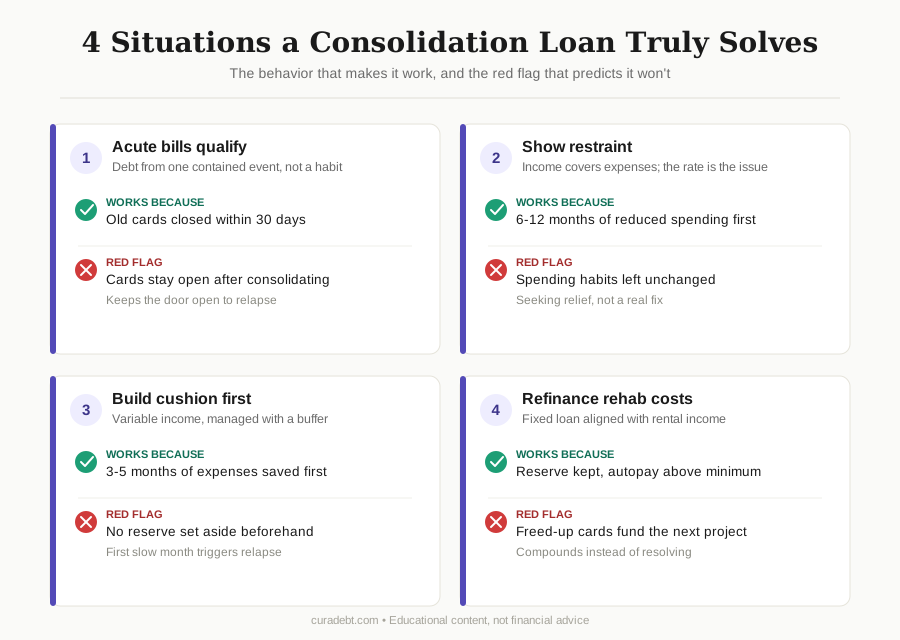
| Situation | Why Consolidation Works | The Behavior That Seals It | Red Flag |
|---|---|---|---|
| Acute Bills Qualify, Close Cards Quickly | Debt from a single contained event, not an ongoing pattern | Close all paid-off cards within 30 days | Cards stay open after consolidating |
| Show Restraint, Correct Budget Mismatch | Income covers expenses; rates are the problem, not the math | 6 to 12 months of reduced discretionary spending before applying | Spending pattern unchanged from when debt accumulated |
| Build Cushion First, Avoid New Charges | Variable income can be managed with the right buffer in place | 3 to 5 months of essential expenses saved before consolidating | No cash reserve; first slow month triggers relapse |
| Refinance Rehab Costs, Pay Above Minimums | Fixed loan aligns with predictable rental income; rate drop is real | Cash reserve kept; autopay set above minimum every month | Freed-up cards used for the next project before loan is paid down |
Consumer Behaviors That Predict Success or Failure
Every expert in this article pointed to the same conclusion: the loan is a tool. The person using it determines the outcome. Four specific behaviors separate the borrowers who build lasting relief from those who return with more debt.
Behaviors That Predict Success
- Close paid-off credit card accounts within 30 days of consolidating
- Reduce discretionary spending for 6 to 12 months before applying
- Save 3 to 5 months of essential expenses before consolidating
- Set autopay above the minimum every month without exception
- Treat the consolidation as a reset, not a reward
Behaviors That Predict Failure
- Leave old credit cards open and active after consolidating
- Apply with unchanged spending habits from before the debt
- Consolidate with no emergency fund in place
- Pay only the minimum on the new loan each month
- Use freed-up credit lines as available capital for new purchases
If consolidation is not the right fit, that does not mean you are out of options. For situations where the debt load is too large or the income gap too wide for a loan to solve, a debt settlement program or a debt relief consultation may reduce what you actually owe rather than reorganizing it. CuraDebt connects you with the right fit for your situation, whatever that turns out to be.
Frequently Asked Questions
When Does a Debt Consolidation Loan Actually Make Sense?
It makes sense in four specific situations: when the debt comes from a contained event like medical bills, not an ongoing overspending habit; when income genuinely covers expenses and the borrower has already reduced discretionary spending; when a variable-income borrower has built an emergency fund before consolidating; and when an investor is moving project credit card debt to a fixed loan aligned with predictable income. In all four cases, the loan addresses a real structural problem rather than postponing one.
What Credit Score Do You Need for a Debt Consolidation Loan?
Most lenders look for a score of 670 or above to offer competitive rates. Above 740, you are likely to qualify for the best available terms. Below 670, you may still get approved, but the rate may be high enough to erase the savings. If your credit has been damaged by missed payments, a debt relief program that does not require a loan may be a better starting point. Individual results vary.
Does a Debt Consolidation Loan Hurt Your Credit Score?
There is usually a short-term dip from the hard inquiry when you apply. After that, making on-time payments on the new loan helps your payment history, and if you close the paid-off cards your overall credit utilization often drops, which can improve your score over time. Most borrowers who stay current on the new loan see a net positive effect within 6 to 12 months.
Should I Close My Credit Cards After Getting a Consolidation Loan?
Yes, in most cases. Leaving old accounts open after consolidating is one of the clearest predictors of failure. The available credit creates both the opportunity and the temptation to build new balances. Closing the accounts causes a temporary score dip due to changes in utilization and average account age, but the behavioral protection that comes from removing the temptation is worth it for most people.
What Is the Difference Between Debt Consolidation and Debt Settlement?
A consolidation loan replaces multiple balances with one new loan, which you repay in full over a fixed term at a lower rate. Debt settlement negotiates with creditors to accept less than the full balance owed, usually as a lump sum or structured payments. Consolidation works best when income supports full repayment and the rate improvement is meaningful. Settlement works best when the debt load is genuinely too large to pay back in full and you need to reduce the principal, not just reorganize it. CuraDebt connects consumers with both types of programs depending on their situation.
How Long Does It Take to Pay Off a Debt Consolidation Loan?
Most personal consolidation loans run 24 to 60 months. The right term is short enough to limit total interest but long enough that the monthly payment fits your budget without strain. Paying above the minimum and avoiding new card charges is the most reliable way to finish early. The calculator on this page can help you compare timelines based on your actual numbers.
Can I Get a Debt Consolidation Loan With a High Debt-to-Income Ratio?
A high debt-to-income ratio makes approval harder. Most lenders want total monthly debt payments, including the new loan, to stay below 40 to 43 percent of gross monthly income. Above that range, lenders may decline or charge a higher rate that eliminates the savings. Reducing other monthly obligations, increasing income, or addressing the debt through a settlement or relief program first can improve your position before applying.
What Happens if Consolidation Is Not the Right Option for My Situation?
If the debt load is too large, the income gap too wide, or the credit profile too damaged for a consolidation loan to pencil out, other programs may be a better fit. A debt settlement program can negotiate balances down rather than just reorganizing them. A debt management plan through a nonprofit agency can lower interest rates without requiring a new loan. CuraDebt's free consultation looks at the full picture and matches you with the right option, not just the first one that sounds appealing. Individual results vary and not all debts are eligible for all programs.
About the Editor: Eric Pemper
Eric Pemper compiled and edited this guide and brought together the expert commentary featured throughout. He founded CuraDebt in 2001 and has spent more than 25 years in the debt and tax relief industry. A graduate of UC San Diego, Eric built CuraDebt on a straightforward idea: people dealing with debt deserve honest information and a match to the right solution, not a sales pitch for whichever product one company happens to sell. He reviews all editorial content on CuraDebt.com for accuracy, balance, and alignment with that mission.
This page is for informational purposes only and is not legal, financial, or tax advice. CuraDebt is a matching service that connects consumers with independent partner firms; it is not a lender, law firm, or credit counseling agency. The managing member of CuraDebt Systems, LLC is Eric Pemper. BBB A+ Rated and BBB Accredited are two separate designations. Not all debts are eligible for all programs. Individual results vary.