

Capital One Debt Settlement Letter From April 2019
A settlement discussion is only as useful as the agreement that follows it. This page shows the written Capital One record from April 2019. The image and figures below preserve the account-specific evidence while the surrounding guidance explains how to read it.
Check Your Debt Relief Options
No cost to check options. No obligation.
Prefer to talk now? Call 1-877-850-3328What This Capital One Settlement Letter Documents
This archived record is dated April 2019. It identifies a balance of $6,332.61 and a settlement amount of $1,267. The difference between those two stated amounts is displayed as a 80% documented balance reduction.
| Item | What This Letter Shows |
|---|---|
| Creditor Or Account Name | Capital One |
| Document Date | April 2019 |
| Balance Stated In Letter | $6,332.61 |
| Settlement Amount In Letter | $1,267 |
| Documented Balance Reduction | 80% |
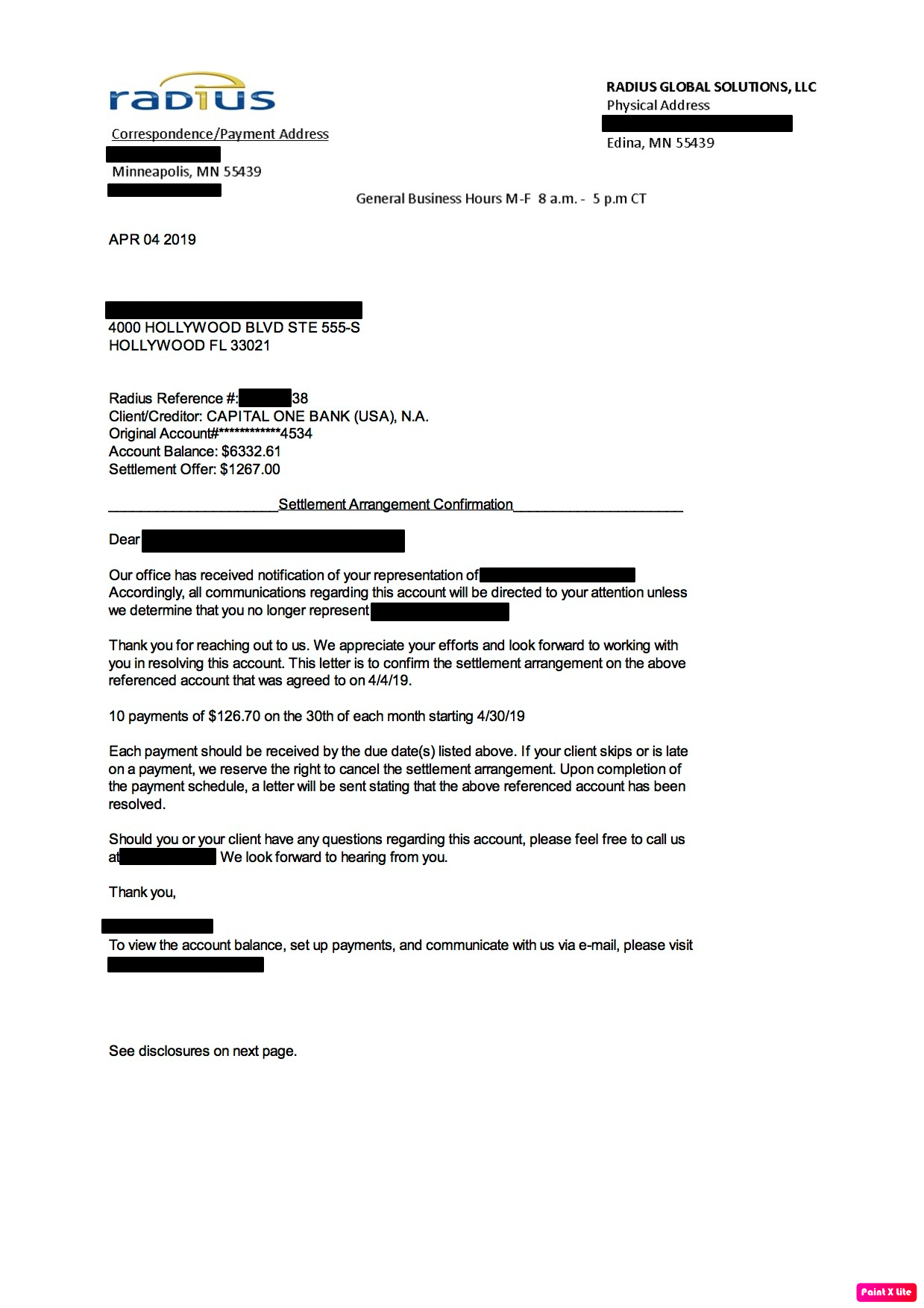
Historical settlement letter kept in the CuraDebt archive. Personal identifying details are redacted for privacy. See more settlement letters.
Calculated only from the balance and settlement amount shown in this letter. This is not net savings and does not include program fees or possible tax consequences.
How To Read This April 2019 Agreement
The page summary makes the arithmetic easier to scan, while the letter image supplies the underlying evidence. Compare the image against the $6,332.61 balance, $1,267 agreed amount, and 80% documented reduction displayed below.
The safest use of a historical example is to learn what should be documented. It should not be used to infer that the same creditor, a collector, or an independent provider will produce the same terms on another account.
A Verification Checklist For This Letter Type
Use the scanned document and the summary together. Before acting on a different agreement, verify each of the following in that agreement's own wording:
- The agreement concerns the intended account
- The amount accepted is not merely a temporary payment
- A missed-payment clause is reviewed if present
- The remaining-balance wording is clear
- Proof of each payment will be retained
When an account has changed hands, confirm whether the sender is the original creditor, a servicer, a collection agency, or the current owner. That distinction can affect which records should be matched before payment.
How To Verify Who Sent The Agreement
Confirm the sender using contact information from an independently verified source, not only the telephone number or link in an unexpected message. Match the account reference and current owner before sending funds, especially when a collector or debt buyer is involved.
For a current account, compare the full written terms with other available paths rather than choosing from a historical percentage alone. Compare debt relief options or review how a debt settlement program is structured.
Document Review Notes For This Specific Example
How To Interpret The 80% Label
Within this account summary, 80% expresses the documented difference as a percentage. That label should not become a promise about current settlement terms. A present-day financial comparison also considers provider fees and possible tax consequences.
Using This Capital One Record In A Broader Comparison
This preserved agreement can answer the figures used in this single example for Capital One. It does not determine one relief path over every alternative. A useful options review includes the person’s accounts, budget, credit goals, and available written terms.
A Paper Trail Built Around $6,332.61 And $1,267
The summary cards place $6,332.61 beside $1,267 to make the two stated amounts scannable. The scanned letter remains the source document. Compare with the cards, then verify with the image.
Questions The April 2019 Letter Can And Cannot Resolve
The preserved letter records who issued it, the two financial figures, and the written schedule. The record does not create today’s offer range or a new account outcome. Check those open questions against current records.
Keeping The Capital One Example Account-Specific
Every displayed reference to $6,332.61, $1,267, plus 80% belongs to one archived account. Keeping them together avoids turning history into a general promise. If two records are reviewed side by side, match the documents on more than percentage alone.
Reading The April 2019 Figures Together
For this archived account Capital One connects its stated amounts with April 2019. The starting number is $6,332.61, and the agreed amount is $1,267. Subtracting those figures produces $5,065.61; the page expresses that difference as 80%.
What The $6,332.61 Balance Establishes
This opening figure $6,332.61 is specific to the document on this page. Readers should not treat it as an eligibility rule or expected account size. For a different account, base the comparison on the current documents.
Why The $1,267 Amount Needs Written Context
The documented figure $1,267 matters only when read beside the rest of the agreement. A figure copied from another page leaves the essential conditions unconfirmed. With a present-day account, read the payment sequence together with the condition for completion.
A Step-By-Step Review Of This Archived Letter
1. Locate The Capital One Account Reference
First reconcile the sender, original creditor, and account reference before relying on payment instructions. On the page shown here, the relevant creditor label is Capital One and the document date is April 2019.
2. Reconcile $6,332.61 With $1,267
Read the opening and accepted figures together. Here the document begins with $6,332.61 with a documented settlement amount of $1,267. If installments appear in another offer, add them independently and confirm the sum matches the written total.
3. Find The Deadline Attached To The $1,267 Figure
An accepted amount is incomplete without timing. Use the image to identify each due date and the required payment method. Current timing must come from the current written offer.
4. Identify The Completion Language Behind 80%
The key clause explains how the remaining balance is treated upon completion. A headline reduction does not answer this question. For the page summary, 80% describes only the mathematical difference between $6,332.61 and $1,267.
5. Preserve Evidence From The April 2019 Record
Keep a complete copy of the agreement together with receipts and bank confirmations. An isolated payment receipt does not show the agreement. The page keeps the account figures connected to their source.
6. Separate The Historical Result From A Current Decision
Once the document review is complete, return to the choices available now. The old result cannot price a new settlement. Compare affordability, total cost, timing, account status, and credit priorities before choosing among repayment, consolidation, debt management, settlement, or another available route.
7. Use The Capital One Letter As Evidence, Not A Promise
The reliable takeaway stays account-specific: this dated record documents the shown balance and settlement amount. It should not be generalized into typical performance. That distinction lets the page remain useful for research without presenting $6,332.61, $1,267, or 80% as a prediction.
Comparison Questions Raised By This Letter
Was The $1,267 Amount A Lump Sum Or Installments?
The payment structure requires the full document. Inspect the April 2019 image for one due date or a sequence of dates. When evaluating another proposal, compare the complete amount, the time allowed, and what occurs after a missed installment.
Did Capital One Or Another Account Holder Issue The Letter?
An account can move from an original creditor to a collector or buyer. Verify the issuing party before treating the document as authoritative. Do not skip this step when reviewing current payment instructions.
Does The 80% Figure Predict Credit Impact?
No percentage in a settlement letter can do that. Credit outcomes depend on the starting file, account history, balances, and reporting. The 80% label on this page remains limited to the difference between $6,332.61 and $1,267.
Could The $6,332.61 Account Create A Tax Question?
Canceled debt can have tax consequences in some circumstances. The letter itself does not determine the answer. Retain any Form 1099-C and review the applicable IRS instructions.
How Should This April 2019 Example Be Used Today?
Let it illustrate what a paper trail can contain, without treating it as a present offer. A current decision should compare all available routes. The fact that the archived amount was $1,267 on a $6,332.61 balance does not set terms for another consumer.
What Makes This Capital One Page More Than A Scanned Image?
The page pairs the original image with structured figures and definitions. It lets the image remain primary while making its key data easier to understand. The unique combination here is Capital One, April 2019, $6,332.61, $1,267, and 80%.
Other Historical Capital One Letter Examples
This archive contains more than one Capital One document. The table is provided to compare dated records, not to calculate an average or predict a new result.
| Archived Example | Balance In Letter | Settlement Amount | Documented Reduction* |
|---|---|---|---|
| This Letter | $6,332.61 | $1,267 | 80% |
| 8/20/2003 | $770.08 | $232 | 70% |
| May 2016 | $27,079.92 | $13,539.96 | 50% |
| December 2022 | $3,882.06 | $1,941.03 | 50% |
*Each percentage compares only the balance and settlement amount shown in that letter. It is not net savings and does not include program fees or possible tax consequences.
Frequently Asked Questions
What does this Capital One settlement letter document?
It records one historical account with a stated balance of $6,332.61 and a settlement amount of $1,267. The displayed 80% reduction is calculated from those two figures only.
Is this Capital One letter a current offer?
No. The document is dated April 2019 and belongs to one archived account. It does not state what Capital One or another account owner will offer today.
Is the 80% reduction net savings?
No. It compares the balance and settlement amount in this letter. It does not subtract program fees or account for possible tax consequences, so it should not be described as net savings.
How can I compare this Capital One example with my account?
Use the document to identify terms that should be clear in writing, such as the account, total amount, due dates, and treatment of the remaining balance. Do not use its percentage as an estimate for a different account.
How can the sender of a settlement letter be verified?
Use a trusted statement, the creditor's official website, or another independently verified source to confirm contact information. Do not rely only on details in an unexpected message before sending funds.
What should be checked after the final settlement payment?
Keep proof of payment and compare later account records with the written terms. If a balance or status appears inconsistent, use the agreement and receipts when requesting a review or correction.
Can credit impact be the same for everyone?
No. Credit effects depend on the person's starting profile, account history, reporting, balances, and the option used. A historical letter cannot predict the impact on another person's credit.
Why are personal details removed from the displayed letter?
Names, addresses, and account details are redacted to protect privacy. The creditor name and financial terms needed to understand the historical example remain visible.
